
Heart Valve Replacement Surgery: When Is It Needed, Types of Valves, Procedure, Risks and Recovery?
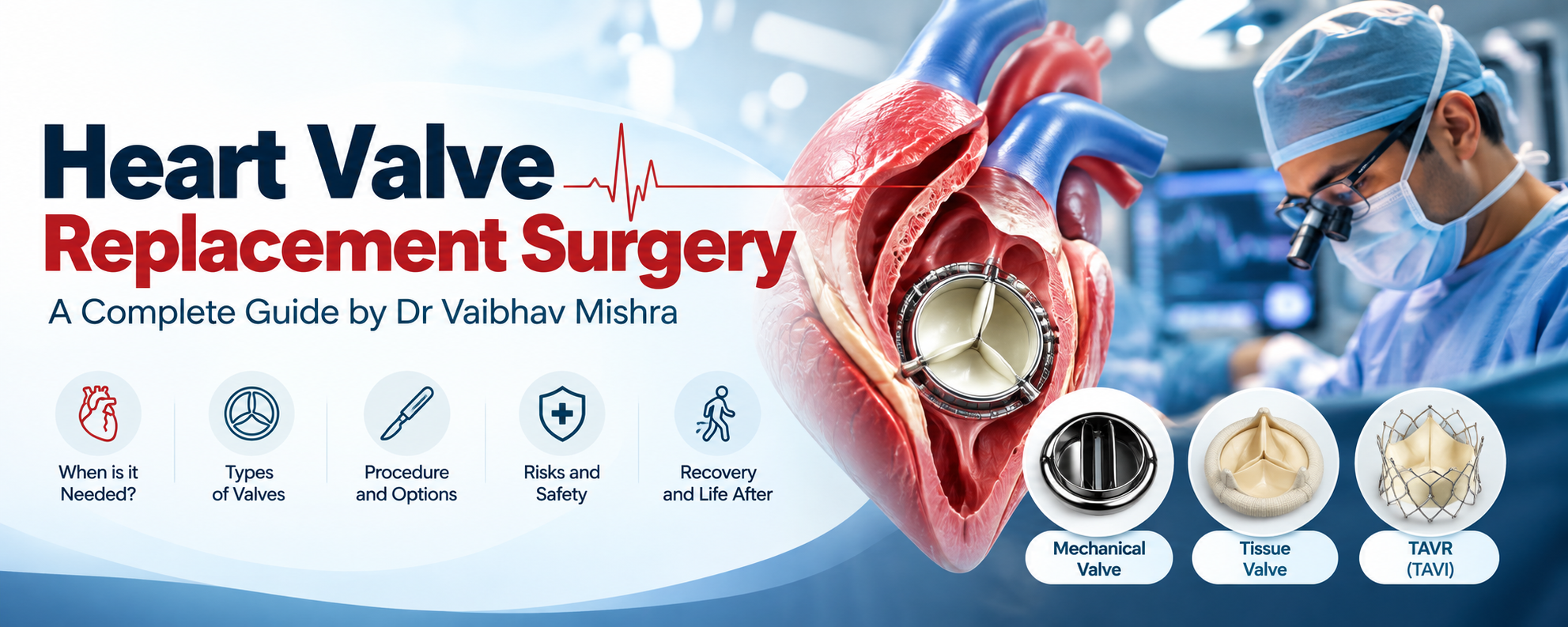
Heart valve disease can remain silent for years. Some patients continue their normal routine without realising that one of their heart valves has become significantly narrowed or is leaking. As the condition progresses, however, the heart has to work increasingly harder to maintain adequate blood circulation.
Patients may gradually develop breathlessness, unusual tiredness, chest discomfort, palpitations, swelling of the feet or reduced ability to perform activities that were previously easy.
When a heart valve becomes severely damaged and repair is either not possible or unlikely to provide a durable result, heart valve replacement surgery may be recommended.
Modern valve treatment has evolved considerably. Depending on the valve involved, the patient’s age, anatomy, severity of disease and overall health, treatment may include conventional surgical valve replacement, minimally invasive heart surgery or, in selected situations, catheter-based valve procedures.
The important question is therefore not simply, “Do I need valve replacement?”
The more appropriate questions are:
Which valve is affected? How severe is the disease? Can the valve be repaired? If replacement is necessary, which valve and which approach would be appropriate for me?
These decisions should be individualised rather than based on one treatment strategy for every patient.
Understanding the Heart Valves
The human heart contains four valves:
- Aortic valve
- Mitral valve
- Tricuspid valve
- Pulmonary valve
These valves act like one-way doors. They open to allow blood to move forward and close to prevent blood from flowing backwards.
Two major problems can affect a heart valve.
Valve Stenosis
Stenosis means that the valve has become narrowed and cannot open properly.
The heart therefore has to generate greater pressure to push blood through the narrowed opening.
One of the most important examples is aortic stenosis, in which the aortic valve becomes progressively narrowed.
Valve Regurgitation
Regurgitation, also called valve leakage or insufficiency, occurs when the valve does not close completely.
As a result, some blood flows backwards rather than moving in the correct direction.
Severe regurgitation can gradually cause enlargement of the heart chambers and deterioration in heart function.
Both severe stenosis and severe regurgitation may eventually require an intervention.
What Is Heart Valve Replacement Surgery?
Heart valve replacement is a procedure in which a severely diseased heart valve is replaced with a prosthetic valve.
Depending on the condition, this may involve replacing the:
Aortic valve — Aortic Valve Replacement (AVR)
or
Mitral valve — Mitral Valve Replacement (MVR)
Other valves may also require intervention in particular clinical situations.
Replacement valves are broadly divided into:
- Mechanical valves
- Biological or tissue valves
For selected patients with aortic stenosis, a valve may also be implanted using a catheter-based technique known as Transcatheter Aortic Valve Replacement (TAVR) or Transcatheter Aortic Valve Implantation (TAVI).
The correct treatment depends on multiple factors and should be decided after detailed evaluation.
When Is Valve Replacement Surgery Needed?
Not every patient diagnosed with valve disease needs immediate surgery.
Mild and some moderate valve diseases may initially be monitored through regular clinical evaluation and echocardiography.
Medications can sometimes help control symptoms, blood pressure, heart rhythm or fluid retention. However, medicines generally cannot physically correct a valve that has become severely narrowed or structurally damaged.
Valve intervention may be considered when the disease becomes severe, particularly when symptoms develop or the valve problem begins affecting the heart’s function.
Current international guidelines emphasise appropriate timing of intervention, careful imaging and multidisciplinary Heart Team assessment for patients with significant valvular heart disease.
Some situations in which intervention may be considered include:
- Severe Aortic Stenosis
When the aortic valve becomes severely narrowed, blood cannot easily leave the heart.
Patients may experience:
- Breathlessness
- Chest pain or pressure
- Dizziness
- Fainting
- Reduced exercise capacity
- Increasing fatigue
Severe symptomatic aortic stenosis is an important condition that requires specialist assessment for valve intervention.
- Severe Aortic Regurgitation
When the aortic valve leaks significantly, blood returns from the aorta into the left ventricle.
Over time, this additional volume can enlarge and weaken the left ventricle.
Surgery may therefore sometimes be recommended before severe symptoms develop if investigations show that the heart is beginning to be adversely affected.
- Severe Mitral Valve Disease
The mitral valve can become either narrowed or severely leaky.
Importantly, mitral valve replacement is not automatically the first option for every patient with mitral regurgitation.
Whenever technically feasible and likely to provide a durable result, preserving and repairing the patient’s own mitral valve may be preferred.
Replacement becomes important when the valve cannot be repaired satisfactorily or when the underlying pathology makes replacement a more appropriate option.
Symptoms That Should Not Be Ignored
Valve disease symptoms can develop slowly.
Because the deterioration may be gradual, some people unconsciously reduce their activity and therefore underestimate the seriousness of their symptoms.
Warning signs can include:
Breathlessness
Initially this may occur while climbing stairs or walking quickly. More advanced disease may cause breathlessness during routine activities or even at rest.
Unusual fatigue
The patient may feel tired despite adequate sleep or find that previously easy activities have become difficult.
Chest discomfort
Chest pain or heaviness can occur, particularly in severe aortic stenosis.
Dizziness or fainting
This is particularly concerning when associated with exertion.
Palpitations
Some valve disorders can be associated with abnormal heart rhythms such as atrial fibrillation.
Swelling of the legs
Fluid accumulation may occur when the heart begins struggling to maintain circulation effectively.
The presence of these symptoms does not automatically mean that valve replacement is required, but they warrant cardiac evaluation.
How Is Heart Valve Disease Diagnosed?
A detailed evaluation is essential before deciding whether valve surgery is required.
Echocardiography
An echocardiogram or 2D Echo is one of the most important investigations for heart valve disease.
It can provide information about:
- Which valve is affected
- Degree of stenosis
- Severity of leakage
- Valve anatomy
- Heart chamber size
- Pumping function
- Pressure within different parts of the heart
Serial echocardiograms are also useful for understanding whether valve disease is stable or progressing.
ECG
An electrocardiogram can identify abnormalities in heart rhythm and other changes associated with cardiac disease.
Transesophageal Echocardiography
A TEE may be advised when more detailed imaging of the valve is required, particularly when planning certain valve procedures.
CT Scan
Cardiac CT plays an important role in selected patients, particularly when planning TAVR/TAVI or assessing the aorta and valve anatomy.
Coronary Angiography
Some patients being considered for valve surgery may also require assessment of the coronary arteries.
If significant coronary artery blockages are identified, coronary bypass surgery may sometimes be performed during the same operation as valve surgery.
Valve Repair or Valve Replacement: Which Is Better?
This is one of the most common questions patients ask.
The answer depends primarily on which valve is affected and what has caused the valve disease.
When a valve can be repaired reliably and the repair is expected to remain durable, preserving the natural valve may offer important advantages.
This is particularly relevant for several forms of mitral valve disease.
However, repair is not always possible.
A valve may be severely calcified, damaged, deformed or affected by disease in a manner that makes a durable repair unlikely.
In these situations, valve replacement may provide the more reliable solution.
Therefore, a patient’s evaluation should ideally answer two separate questions:
Can this valve be repaired?
and
If it cannot be repaired reliably, what is the most appropriate replacement strategy?
Mechanical Valve vs Tissue Valve: Which One Should You Choose?
One of the most important decisions before surgical valve replacement is choosing between a mechanical valve and a bioprosthetic or tissue valve.
There is no single valve that is right for everyone.
Mechanical Heart Valve
Mechanical valves are manufactured using highly durable materials and are designed for long-term durability.
Potential advantage
Their major advantage is durability, making them an important option for appropriately selected younger patients.
Important consideration
Mechanical valves generally require lifelong anticoagulation with a vitamin K antagonist such as warfarin to reduce the risk of blood clot formation on the valve.
This means the patient requires ongoing monitoring and careful adherence to anticoagulant treatment.
Bleeding risk, lifestyle, pregnancy considerations, ability to maintain anticoagulation and individual preference therefore become important parts of the discussion.
Biological or Tissue Valve
Biological valves are generally made using treated animal tissue, although other biological prostheses also exist.
Potential advantage
They usually avoid the need for lifelong anticoagulation solely because of the valve itself, although some patients may still need anticoagulants for other medical reasons.
Important consideration
Unlike mechanical valves, tissue valves can undergo structural deterioration over time.
The durability varies considerably between patients and can be influenced by factors including age.
For this reason, choosing between a tissue and mechanical valve should involve a detailed discussion about:
- Patient’s age
- Expected longevity
- Anticoagulation
- Bleeding risk
- Lifestyle
- Future interventions
- Other diseases
- Patient preference
Modern valve treatment increasingly takes a lifetime management approach rather than looking only at the immediate operation.
What Is TAVR or TAVI?
TAVR — Transcatheter Aortic Valve Replacement, also called TAVI — Transcatheter Aortic Valve Implantation, is a catheter-based technique used primarily to treat severe aortic stenosis.
Unlike surgical valve replacement, the chest does not usually need to be opened through a conventional sternotomy.
A catheter carrying a collapsible biological valve is commonly introduced through an artery, often through the groin.
The replacement valve is positioned inside the patient’s diseased aortic valve and expanded. The new valve then begins controlling blood flow.
TAVR has transformed the treatment of aortic stenosis and can now be considered across different surgical-risk groups in appropriately selected patients.
However, this does not mean TAVR is automatically preferable to surgery for every patient.
Age, anatomy, life expectancy, coronary disease, bicuspid valve anatomy, access route, durability considerations and the possibility of other cardiac procedures all influence the decision.
The choice between SAVR (Surgical Aortic Valve Replacement) and TAVR should therefore be personalised after Heart Team assessment.
What Happens During Surgical Valve Replacement?
The exact technique varies depending on the valve and surgical approach.
In conventional heart valve surgery, the patient receives general anaesthesia.
The surgeon accesses the heart, and a heart-lung machine is generally used temporarily to maintain circulation while the valve is being operated upon.
The diseased valve is carefully assessed.
If replacement is required, the damaged valve or relevant components are removed and the selected prosthetic valve is implanted securely.
The surgeon then verifies valve function and the patient is gradually separated from cardiopulmonary bypass.
The chest is subsequently closed and the patient is transferred to intensive care for postoperative monitoring.
Can Valve Replacement Be Performed Through Minimally Invasive Heart Surgery?
In selected patients, yes.
Advances in cardiac surgery allow some valve procedures to be performed through smaller incisions rather than a full conventional sternotomy.
Depending upon the patient’s anatomy and type of valve disease, minimally invasive valve surgery may potentially offer:
- Smaller incision
- Reduced surgical trauma
- Less visible scarring
- Earlier mobilisation in suitable patients
- Potentially faster recovery
However, the smallest incision should never be the primary objective.
The fundamental objective is a safe, effective and durable valve procedure.
Some patients are better suited to conventional surgery because of complex valve pathology, previous surgery, multiple cardiac procedures or other anatomical considerations.
The surgical approach therefore needs to be personalised.
What Are the Risks of Heart Valve Replacement Surgery?
Heart valve replacement is a major cardiac procedure, and like any major operation it carries potential risks.
These can include:
- Bleeding
- Infection
- Abnormal heart rhythm
- Stroke
- Blood clots
- Kidney problems
- Reaction to anaesthesia
- Valve-related complications
- Need for pacemaker in certain situations
- Heart or respiratory complications
The actual risk varies substantially between patients.
An otherwise healthy patient undergoing an isolated valve procedure may have a very different risk profile from an older patient with kidney disease, diabetes, lung disease, previous heart surgery or poor heart function.
This is why surgical risk should be assessed individually rather than quoted as one general percentage for everyone.
Recovery After Heart Valve Replacement Surgery
Recovery depends on the type of surgery, age, preoperative heart function and overall health.
After surgery, patients are initially monitored in the cardiac intensive care unit.
Once stable, they are encouraged to begin gradual mobilisation.
Pain management, breathing exercises and physiotherapy form important parts of early recovery.
Patients undergoing conventional sternotomy also need sufficient time for the breastbone to heal.
After discharge, activity is gradually increased according to the treating team’s instructions.
Many patients eventually return to a considerably more active lifestyle once the heart has recovered and the valve is functioning effectively.
Cardiac rehabilitation may be recommended to help patients return safely to exercise and normal activities.
Life After Heart Valve Replacement
Valve replacement does not mean that cardiac follow-up ends after surgery.
Long-term care remains extremely important.
Patients should continue regular consultations and undergo echocardiography when advised.
Those with mechanical valves require particularly careful anticoagulation management.
Other important aspects include:
- Taking prescribed medicines consistently
- Maintaining appropriate blood pressure
- Managing diabetes and cholesterol
- Maintaining a heart-healthy diet
- Regular physical activity as advised
- Maintaining a healthy weight
- Avoiding tobacco
- Maintaining good dental and oral hygiene
- Informing doctors and dentists about the prosthetic heart valve
Patients should also discuss prevention of infective endocarditis with their cardiologist or cardiac surgeon, including when antibiotic prophylaxis is appropriate for certain dental procedures.
Can a Replacement Heart Valve Last Forever?
This depends largely on the type of valve.
Mechanical valves are designed to be highly durable, although they require lifelong anticoagulation.
Biological valves have limited durability and can eventually develop structural degeneration.
The possibility of future intervention is therefore an important consideration, particularly when a tissue valve is chosen for a relatively young patient.
Fortunately, treatment options for failing biological valves have also evolved.
In selected patients, a transcatheter valve-in-valve procedure may sometimes be possible instead of repeat open-heart surgery.
However, whether this will be technically feasible in the future depends on the original valve size, anatomy and several other factors.
This is another reason why the first valve operation should ideally be planned with the patient’s lifetime cardiac strategy in mind.
How Do I Choose a Valve Replacement Surgeon in Delhi?
Patients frequently search online for the best valve replacement surgeon in Delhi, best heart valve surgeon in Delhi, best cardiac surgeon in Delhi NCR or best surgeon for valve replacement surgery.
Instead of relying only on such labels, patients should consider objective factors while selecting a cardiac surgeon and centre.
Important questions include:
Does the surgeon regularly perform valve procedures?
Valve surgery requires detailed understanding of valve anatomy and the ability to decide appropriately between repair and replacement.
Are both repair and replacement options evaluated?
An experienced valve programme should not automatically replace every diseased valve. The possibility of repair should be considered whenever clinically appropriate.
Are minimally invasive options available?
The surgeon should be able to determine whether minimally invasive surgery offers a meaningful advantage in the individual patient’s case.
Is there a multidisciplinary Heart Team?
Modern valve treatment increasingly involves cardiac surgeons, interventional cardiologists, imaging specialists, cardiac anaesthesiologists and critical-care specialists.
Is the decision personalised?
Age alone should not determine treatment.
The patient’s anatomy, symptoms, heart function, other diseases, lifestyle, anticoagulation preferences and long-term treatment strategy should all be considered.
Frequently Asked Questions About Valve Replacement Surgery
Is valve replacement an open-heart surgery?
Surgical valve replacement is generally performed as heart surgery using cardiopulmonary bypass. Depending on the condition and expertise available, some operations may be performed through minimally invasive approaches.
TAVR/TAVI, by contrast, is a catheter-based procedure for selected aortic valve patients.
Which is better: mechanical or tissue valve?
Neither is universally better.
Mechanical valves offer excellent durability but generally require lifelong anticoagulation. Tissue valves usually avoid lifelong anticoagulation solely because of the prosthesis but can deteriorate over time.
The decision should be individualised.
Is TAVR better than open-heart valve replacement?
Not necessarily.
TAVR is an excellent treatment for appropriately selected patients with severe aortic stenosis, while surgical valve replacement remains an important and sometimes preferable treatment for others.
The decision should be made according to the patient’s anatomy, age, clinical condition and lifetime treatment strategy.
Can valve disease be treated without surgery?
Mild or moderate valve disease may often be monitored.
Medicines can control some symptoms and associated conditions but generally cannot correct a severely narrowed or structurally damaged valve.
Can a leaking valve be repaired instead of replaced?
Yes, in selected patients.
This is particularly relevant for mitral valve disease. When a durable repair is technically feasible, preserving the patient’s natural valve may be preferred.
What is the success rate of valve replacement surgery?
There is no meaningful single success percentage applicable to every patient.
Outcomes depend on the valve involved, severity of disease, heart function, patient’s age, associated medical conditions, whether additional cardiac surgery is required and overall surgical risk.
An individual risk assessment provides much more useful information than a general percentage found online.
Final Thoughts
Heart valve replacement has evolved from being a single surgical operation into a broad spectrum of treatment possibilities.
Today, the discussion may include:
Valve repair versus valve replacement
Mechanical versus tissue valve
Conventional versus minimally invasive surgery
Surgical aortic valve replacement versus TAVR
The right decision is therefore not simply about choosing a procedure.
It is about choosing the right procedure, for the right patient, at the right stage of the disease.
If you have been diagnosed with severe aortic stenosis, aortic regurgitation, mitral valve disease or another significant valve disorder, timely evaluation by an experienced cardiac team is important.
Early specialist assessment allows the condition to be monitored carefully and, when intervention becomes necessary, provides an opportunity to plan treatment before irreversible heart damage develops.
About Dr Vaibhav Mishra
Dr Vaibhav Mishra is a senior cardiac surgeon with expertise in cardiac surgical procedures, including complex and minimally invasive approaches. Patients seeking information about heart valve replacement surgery in Delhi, minimally invasive valve surgery, aortic valve replacement, mitral valve surgery, or searching for a valve replacement surgeon in Delhi can seek a detailed cardiac surgical evaluation to understand the treatment options appropriate for their individual condition.
This article is intended for patient education and should not replace individual medical consultation. Treatment recommendations for valve disease depend on clinical examination, imaging findings, associated medical conditions and multidisciplinary assessment.