
Robotic CABG in India: Benefits, Procedure, Recovery and Who May Be Eligible
Coronary artery disease remains one of the most important causes of heart disease worldwide. When coronary arteries become significantly narrowed or blocked, coronary artery bypass grafting (CABG) may be recommended to restore blood flow to the heart muscle.
Traditionally, CABG has been performed through a median sternotomy, which involves opening the breastbone to access the heart. Advances in cardiac surgery have introduced less invasive approaches, including robotic-assisted coronary artery bypass grafting, commonly known as robotic CABG.
In 2026, robotic CABG continues to attract attention because it combines advanced surgical technology with the principles of minimally invasive cardiac surgery. Recent research, including a 2026 Indian study, has evaluated robotic-assisted CABG in comparison with conventional CABG and highlighted its potential role in appropriately selected patients.
But robotic CABG is not simply a matter of replacing conventional surgery with a robot. It is a highly specialised procedure that requires careful patient selection, advanced equipment and a cardiac surgical team experienced in robotic and minimally invasive techniques.
What Is Robotic CABG?
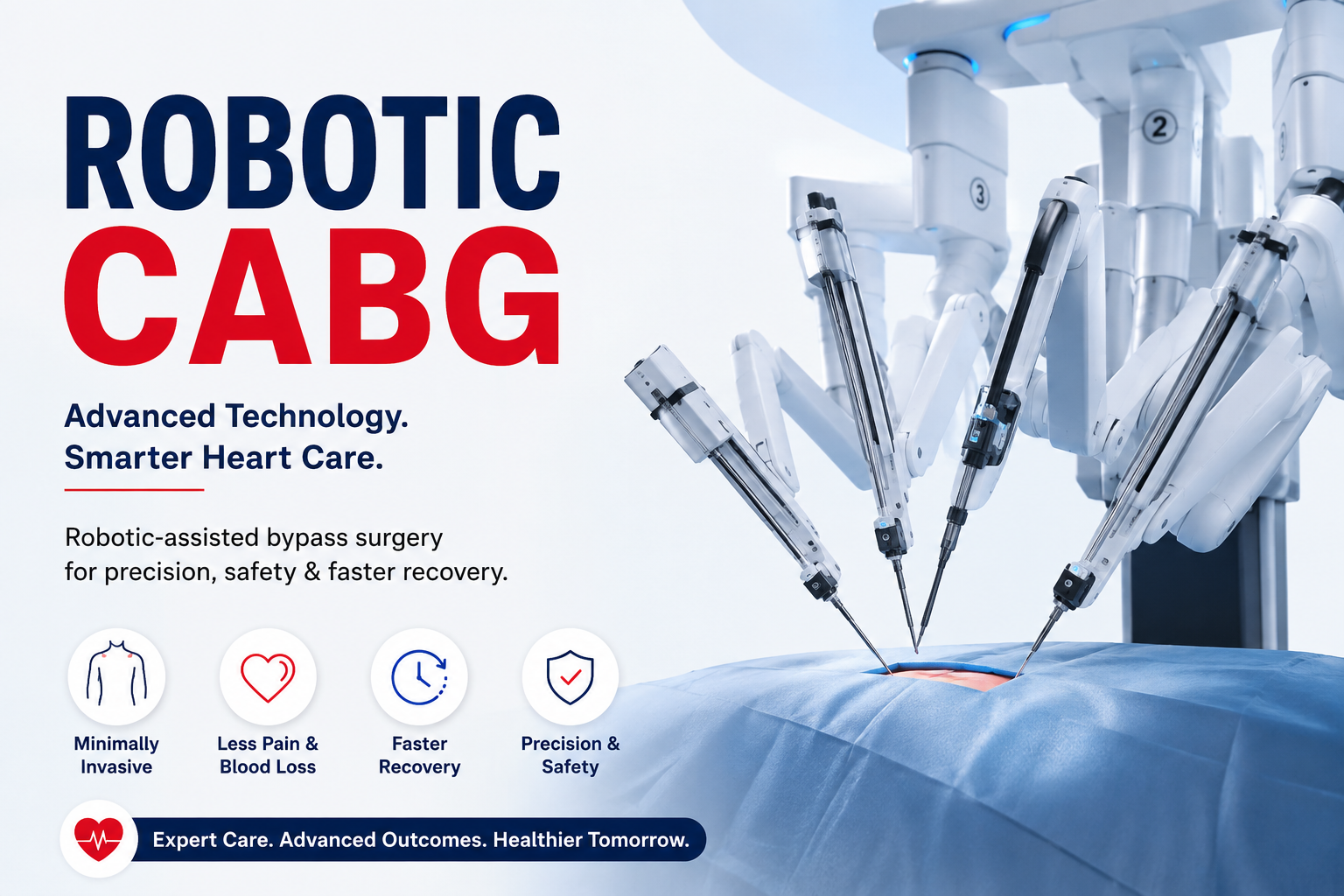
Robotic coronary artery bypass grafting (robotic CABG) is a minimally invasive form of coronary bypass surgery in which specialised robotic instruments are used to assist the cardiac surgeon.
Instead of making a large incision through the centre of the chest, the surgeon works through several small openings in the chest using a robotic surgical system. The surgeon controls the instruments from a console and performs the operation with enhanced visualisation and precise instrument movements.
The robot does not independently perform the surgery. The cardiac surgeon remains in control throughout the procedure.
Robotic-assisted coronary revascularisation can include approaches such as robotic-assisted internal mammary artery harvesting and minimally invasive or totally endoscopic coronary artery bypass procedures.
How Does Robotic CABG Work?
The exact technique depends on the patient’s coronary anatomy, the number and location of blocked arteries and the planned surgical strategy.
A typical robotic-assisted approach may involve:
- Preoperative evaluation – The heart and coronary arteries are assessed using appropriate imaging and cardiac investigations.
- Anaesthesia – The patient is placed under general anaesthesia.
- Small chest incisions – Ports are created between the ribs instead of opening the breastbone.
- Robotic assistance – The surgeon controls specialised instruments from a console.
- Internal mammary artery harvesting – In appropriate cases, the internal mammary artery can be harvested using robotic assistance.
- Bypass grafting – The harvested artery or other suitable conduit is connected beyond the blocked coronary artery to improve blood flow.
- Completion and monitoring – The surgical team confirms the result and the patient is transferred for postoperative monitoring.
The exact operation varies considerably from patient to patient. Some procedures may involve a hybrid approach combining robotic or minimally invasive surgery with other techniques.
What Are the Potential Benefits of Robotic CABG?
One of the main reasons robotic CABG has attracted interest is that it can provide coronary revascularisation through a less invasive approach in appropriately selected patients.
Potential advantages may include:
- Smaller incisions
Robotic techniques use small chest incisions rather than the traditional central chest incision used for conventional sternotomy-based CABG.
- No traditional breastbone division in selected approaches
Certain minimally invasive robotic procedures can avoid median sternotomy. This may be particularly relevant to patients concerned about recovery associated with healing of the breastbone.
- Potentially less postoperative discomfort
Smaller incisions and avoidance of sternotomy may reduce some aspects of postoperative discomfort, although pain varies from patient to patient.
- Faster functional recovery in selected patients
A less invasive surgical approach may allow some appropriately selected patients to return to normal activities sooner than after conventional sternotomy-based surgery.
- Enhanced surgical visualisation
The robotic platform provides the surgeon with magnified, high-definition visualisation and specialised instruments designed to facilitate precise movements in confined spaces.
However, these potential advantages should not be interpreted as a guarantee that robotic CABG will produce a better outcome for every patient.
Is Robotic CABG Safer Than Conventional CABG?
This is one of the most important questions patients ask.
The current evidence does not support a simple statement that robotic CABG is universally safer or superior to conventional CABG.
A 2026 meta-analysis examining 27 studies found no significant difference between robotic and conventional CABG in mortality, reintervention or graft patency. The researchers concluded that overall outcomes were comparable, although operative times varied according to the procedure and number of vessels involved.
This is important because the best surgical approach is not determined by technology alone.
The patient’s coronary anatomy, overall health, disease complexity, previous surgeries, suitability of the target vessels and the experience of the cardiac surgical team all need to be considered.
Who May Be a Candidate for Robotic CABG?
Robotic CABG is generally considered for carefully selected patients rather than automatically offered to everyone who requires bypass surgery.
Potential candidates may include patients with coronary artery disease whose anatomy and clinical condition are suitable for a minimally invasive or robotic approach.
The assessment may consider:
- Location and severity of coronary blockages
- Number of diseased coronary arteries
- Quality and size of the target vessels
- Previous cardiac or chest surgery
- Lung function
- Body habitus
- Overall medical condition
- Whether complete revascularisation can be achieved using the proposed technique
- Availability and experience of the surgical team
A detailed evaluation is therefore essential before deciding whether robotic CABG is appropriate.
When May Conventional CABG Be More Appropriate?
Robotic surgery is not suitable for every patient.
Patients with very complex coronary artery disease, challenging anatomy or other medical factors may be better served by conventional CABG or another revascularisation strategy.
The objective of treatment should always be the safest and most effective form of complete revascularisation for the individual patient, rather than choosing a particular technology simply because it is newer.
This is why consultation with an experienced cardiac surgeon is essential before making a decision.
Robotic CABG vs Conventional CABG
| Feature | Robotic CABG | Conventional CABG |
| Surgical access | Small chest incisions in selected approaches | Usually median sternotomy |
| Breastbone | Can be avoided in selected procedures | Usually divided |
| Surgical technology | Robotic-assisted instruments | Conventional surgical instruments |
| Visualisation | Magnified robotic view | Direct surgical view |
| Patient selection | More selective | Broad range of CABG patients |
| Recovery | Potentially faster in selected patients | Well-established recovery pathway |
| Suitability | Depends strongly on anatomy and expertise | Suitable for many complex cases |
| Evidence | Growing | Extensive long-term evidence |
The choice should be individualised rather than based solely on the size of the incision.
Robotic CABG and Minimally Invasive CABG: Are They the Same?
Not exactly.
Minimally invasive CABG is a broader term covering coronary bypass procedures performed through smaller incisions and without conventional median sternotomy.
Robotic CABG refers specifically to coronary bypass surgery performed with robotic assistance.
Robotic techniques may therefore form part of a minimally invasive cardiac surgery programme.
Two recognised robotic-assisted strategies include minimally invasive direct coronary artery bypass (MIDCAB) and totally endoscopic coronary artery bypass (TECAB).
What Does Recovery After Robotic CABG Look Like?
Recovery varies depending on the exact procedure, the patient’s health and whether additional procedures are performed.
Because selected robotic approaches avoid a traditional sternotomy, recovery can differ from conventional CABG. However, patients should not assume that robotic surgery means an immediate return to normal life.
After surgery, patients still need:
- Monitoring and postoperative care
- Medication as prescribed
- Gradual physical activity
- Cardiac rehabilitation where recommended
- Follow-up with the cardiac team
- Long-term management of cholesterol, blood pressure, diabetes and other cardiovascular risk factors
CABG treats the consequences of coronary artery disease but does not eliminate the underlying risk factors.
Long-term prevention therefore remains an essential part of successful heart treatment. The American Heart Association issued an updated scientific statement on secondary prevention after CABG in 2026, reinforcing the importance of ongoing cardiovascular risk-factor management after bypass surgery.
Is Robotic CABG Available in India?
Robotic-assisted CABG is available in specialised cardiac centres in India, although it remains a highly specialised procedure.
Importantly, the availability of a robotic surgical system alone does not determine whether a patient should undergo robotic CABG.
Experience matters.
A 2026 study from India specifically examined robotic-assisted CABG and the associated learning curve, highlighting the importance of developing appropriate expertise with the technique.
Patients considering robotic bypass surgery should therefore ask about the cardiac team’s experience with the specific procedure being proposed, rather than focusing only on the presence of robotic technology.
Does Robotic CABG Mean the Robot Performs the Operation?
No.
This is one of the most common misconceptions about robotic surgery.
The robotic system is a surgical platform controlled by the cardiac surgeon. It translates the surgeon’s hand movements into precise movements of specialised instruments.
The surgeon remains responsible for planning and performing the operation.
Therefore, the expertise of the cardiac surgeon and the entire multidisciplinary cardiac team remains central to the success of the procedure.
What Questions Should You Ask Before Choosing Robotic CABG?
If robotic CABG has been suggested, patients may want to discuss:
- Am I a suitable candidate for robotic CABG?
- How many coronary arteries need bypass surgery?
- Can complete revascularisation be achieved using the minimally invasive approach?
- What type of robotic procedure is being recommended?
- Will the breastbone need to be opened?
- What are the potential benefits and limitations in my specific case?
- What happens if the minimally invasive approach cannot be completed as planned?
- How experienced is the cardiac surgical team with this procedure?
- What should I expect during recovery?
These questions can help patients make an informed decision based on their individual condition.
What Does the Future Hold for Robotic CABG?
Robotic coronary surgery continues to evolve.
Recent 2026 research has added to the evidence base, including studies examining outcomes, learning curves and longer-term results. A recent population-level analysis has also contributed to the discussion around broader adoption of robotic coronary bypass surgery.
At the same time, robotic CABG remains a technically demanding procedure, and more evidence is needed to define exactly which patients benefit most from robotic approaches compared with other forms of coronary revascularisation.
The future is likely to involve better patient selection, improved surgical platforms, greater surgeon experience and continued research into long-term outcomes.
Conclusion
Robotic CABG represents an important development in minimally invasive cardiac surgery.
For appropriately selected patients, robotic-assisted bypass surgery can provide coronary revascularisation through smaller chest incisions and may offer recovery-related advantages associated with less invasive surgical access.
However, robotic CABG is not automatically better than conventional bypass surgery, and it is not appropriate for every patient. Current 2026 evidence suggests broadly comparable major outcomes between robotic and conventional CABG, while the potential advantages of a minimally invasive approach need to be balanced against patient selection, procedural complexity and surgical expertise.
The most important decision is therefore not simply “robotic or traditional?” It is:
“Which approach is safest and most appropriate for my coronary disease?”
A detailed evaluation by an experienced cardiac surgeon can help determine the most suitable treatment strategy.
Frequently Asked Questions
What is robotic CABG?
Robotic CABG is a minimally invasive form of coronary artery bypass surgery in which a cardiac surgeon uses a robotic surgical system to perform or assist with specific parts of the bypass procedure.
Is robotic CABG better than traditional bypass surgery?
Not necessarily. Current evidence suggests comparable major outcomes between robotic and conventional CABG, while robotic techniques may provide advantages related to less invasive surgical access in selected patients.
Does robotic CABG avoid opening the chest?
Selected robotic CABG approaches can avoid median sternotomy and use small openings between the ribs. However, the exact surgical approach depends on the patient’s anatomy and planned procedure.
Is robotic CABG suitable for everyone?
No. Patient selection is critical. Coronary anatomy, disease complexity, medical history and the surgical team’s expertise all influence whether robotic CABG is appropriate.
How long does recovery take after robotic CABG?
Recovery varies according to the procedure and individual patient. A less invasive approach may support a faster functional recovery in selected patients, but patients still require postoperative care, medication, follow-up and appropriate rehabilitation.
Is robotic CABG available in India?
Yes, robotic-assisted coronary surgery is performed at specialised centres in India. However, it remains a specialised procedure and should be performed by teams with appropriate expertise and infrastructure.
Is the robot performing the heart surgery?
No. The cardiac surgeon controls the robotic system throughout the operation. The robot is a surgical platform that assists with visualisation and instrument movement.
How do I know whether I am suitable for robotic CABG?
Suitability can only be determined after reviewing your coronary anatomy, medical history, overall health and the specific bypass strategy required. A cardiac surgeon can assess whether robotic, minimally invasive or conventional CABG is the most appropriate option.
Medical Disclaimer
This article is intended for general educational purposes and should not be considered a substitute for medical consultation, diagnosis or treatment. The suitability of robotic CABG varies from patient to patient and should be determined by a qualified cardiac surgery team after individual evaluation.