
Multi-Vessel Heart Blockages: When Is Bypass Surgery Better Than Multiple Stents?
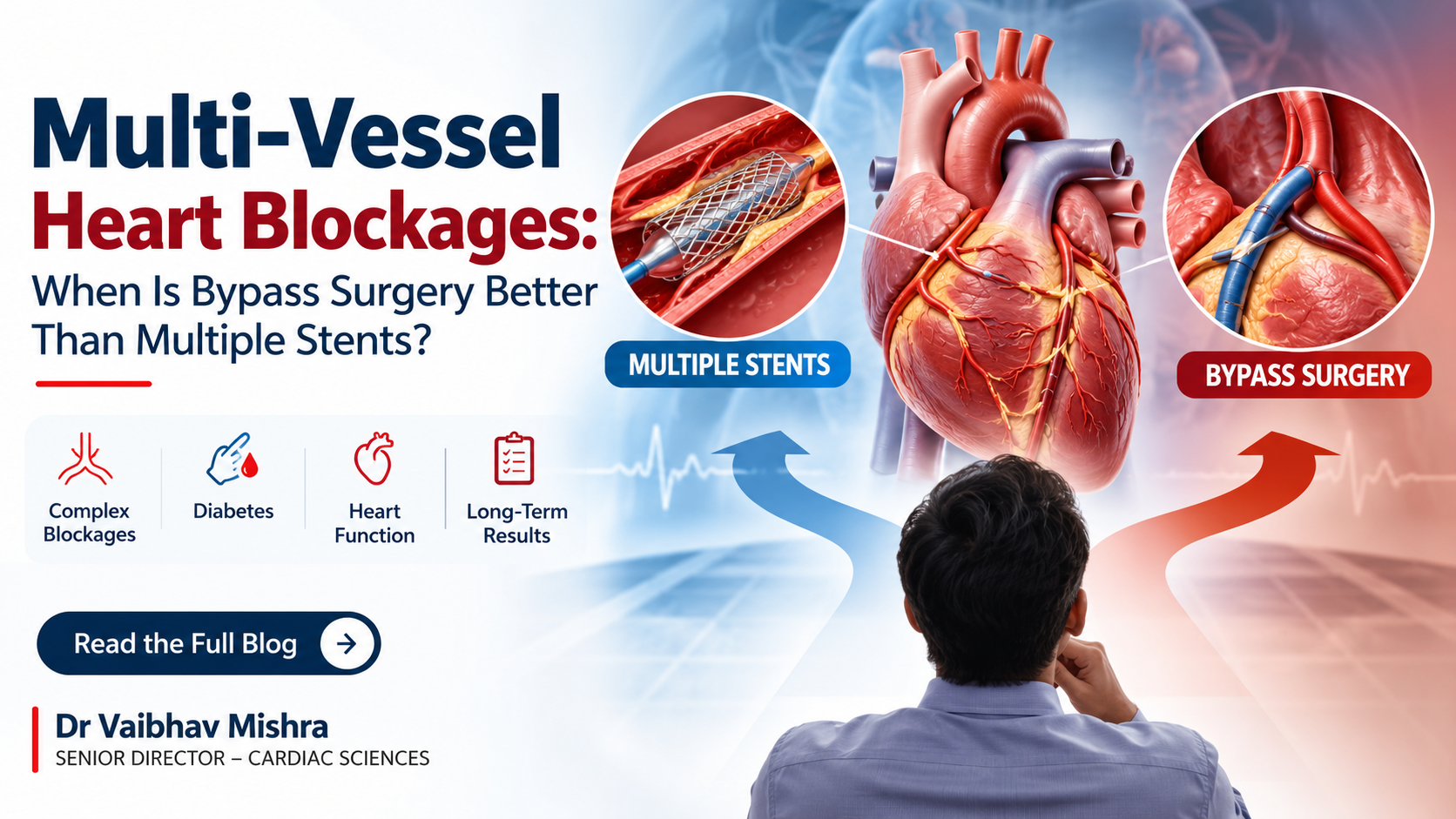
Being told that you have blockages in two or three coronary arteries can be frightening. One of the first questions patients and their families usually ask is:
“Can these blockages be treated with stents, or do I need bypass surgery?”
There is no single answer that applies to every patient.
Two people may both have “three-vessel coronary artery disease” on an angiography, yet the most appropriate treatment for them may be completely different. One may be treated effectively with medicines and lifestyle changes, another may be suitable for angioplasty and stenting, while a third may achieve a more complete and durable revascularization with coronary artery bypass grafting (CABG).
The decision depends not simply on how many blockages are present, but on where they are, how complex they are, how much heart muscle is at risk, whether the patient has diabetes, how well the heart is pumping, and whether complete revascularization can realistically be achieved with PCI or surgery.
Modern cardiology and cardiac surgery therefore increasingly focus on selecting the right treatment for the right patient rather than assuming that one procedure is universally superior.
What Does Multi-Vessel Coronary Artery Disease Mean?
The heart muscle receives oxygen-rich blood through the coronary arteries.
The three major coronary territories are supplied principally by:
- the left anterior descending artery (LAD),
- the left circumflex artery (LCx), and
- the right coronary artery (RCA).
Over time, cholesterol, inflammatory material and calcium can accumulate within the walls of these arteries, producing atherosclerotic plaques. When these plaques significantly narrow the artery, blood supply to the heart muscle may become inadequate, particularly during physical exertion.
When significant coronary artery disease affects more than one major coronary artery or territory, it is generally described as multi-vessel coronary artery disease.
For example, a patient may have significant disease involving the LAD and RCA, or disease affecting all three major coronary territories.
However, saying that someone has “three blockages” or “three-vessel disease” does not tell us everything we need to know.
A 70% narrowing in a short, relatively straightforward segment of an artery is very different from a long, heavily calcified narrowing involving a major branching point. Similarly, disease in a small peripheral vessel does not necessarily carry the same significance as disease affecting the proximal LAD or left main coronary artery.
This is why treatment should never be decided merely by counting the number of blockages.
What Are the Treatment Options?
Broadly, coronary artery disease can be managed through three approaches:
- Guideline-directed medical treatment
Depending on the individual, treatment may include antiplatelet medicines, cholesterol-lowering therapy, medicines for blood pressure, diabetes management and anti-anginal medications.
Lifestyle modification is equally important. This includes regular appropriate exercise, weight management, stopping tobacco use, controlling diabetes and blood pressure, improving diet and managing other cardiovascular risk factors.
Importantly, neither a stent nor bypass surgery “cures” atherosclerosis. Both restore blood supply, but the underlying disease process still requires long-term treatment.
- Angioplasty and stenting – PCI
Percutaneous coronary intervention, or PCI, involves passing a catheter into the coronary artery, usually through an artery in the wrist or groin.
A balloon is used to open the narrowed segment, and in most cases a drug-eluting stent is placed to keep the artery open.
Modern PCI has evolved enormously. Better stents, intravascular imaging and physiological assessment of coronary lesions have enabled interventional cardiologists to treat increasingly complex coronary disease.
- Coronary artery bypass grafting – CABG
CABG takes a different approach.
Instead of opening the blockage from inside the coronary artery, the surgeon creates an alternative route for blood to reach the heart muscle beyond the diseased segment.
Grafts may be obtained from arteries in the chest or arm and, where appropriate, veins from the leg.
One of the most established grafts is the left internal mammary artery (LIMA) to the LAD, valued for its long-term durability.
CABG can therefore bypass several diseased areas during a single operation.
Why Can Bypass Be Advantageous in Complex Multi-Vessel Disease?
The difference becomes easier to understand if we consider the way the two procedures treat coronary disease.
A stent is placed at a particular diseased segment.
A bypass graft, on the other hand, is usually connected to the coronary artery beyond the diseased area, creating a new pathway for blood flow.
Suppose a patient has several long and complex areas of disease involving multiple arteries. Treating each significant segment using PCI may require several stents.
CABG may sometimes provide a more comprehensive revascularization by bypassing multiple areas of disease.
This concept of achieving complete or near-complete revascularization is particularly important in patients with extensive coronary artery disease. Current European guidelines note that complete revascularization is preferable where reasonably achievable, although the appropriate approach depends on anatomy, clinical circumstances and patient characteristics.
When May CABG Be Preferred Over Multiple Stents?
There are several situations in which bypass surgery deserves particularly serious consideration.
Complex three-vessel coronary artery disease
A patient with significant disease involving all three major coronary territories may require multiple stents if PCI is selected.
But the number of vessels alone does not determine treatment.
The complexity of the coronary anatomy matters enormously.
For example:
- Are the blockages long?
- Are they heavily calcified?
- Are major bifurcations involved?
- Are some arteries completely occluded?
- Is disease spread diffusely along the artery?
- Can PCI realistically achieve complete revascularization?
- How much myocardium is supplied by the affected arteries?
For patients with anatomically complex multivessel coronary artery disease who are suitable surgical candidates, CABG has historically demonstrated important advantages, particularly in reducing subsequent spontaneous myocardial infarction and the need for repeat revascularization.
Long-term evidence has also shown that the relative benefit of CABG becomes more apparent as coronary anatomical complexity increases.
However, contemporary evidence has added nuance to this discussion. Modern PCI using physiological guidance and newer-generation drug-eluting stents has substantially improved outcomes, meaning that some patients with three-vessel disease may now reasonably be candidates for either strategy.
Therefore, “three vessels blocked = bypass” is an oversimplification.
Multi-vessel disease with diabetes
Diabetes deserves special attention.
Patients with diabetes often develop a more diffuse pattern of coronary atherosclerosis. Rather than having one isolated short narrowing, disease may extend along substantial portions of several coronary arteries.
This can make treatment with multiple individual stents more challenging.
The ACC/AHA/SCAI coronary revascularization guideline recommends CABG in preference to PCI for suitable patients with diabetes and multivessel coronary artery disease involving the LAD, particularly to reduce mortality and repeat revascularization.
Similarly, European guidance continues to favour CABG in many surg